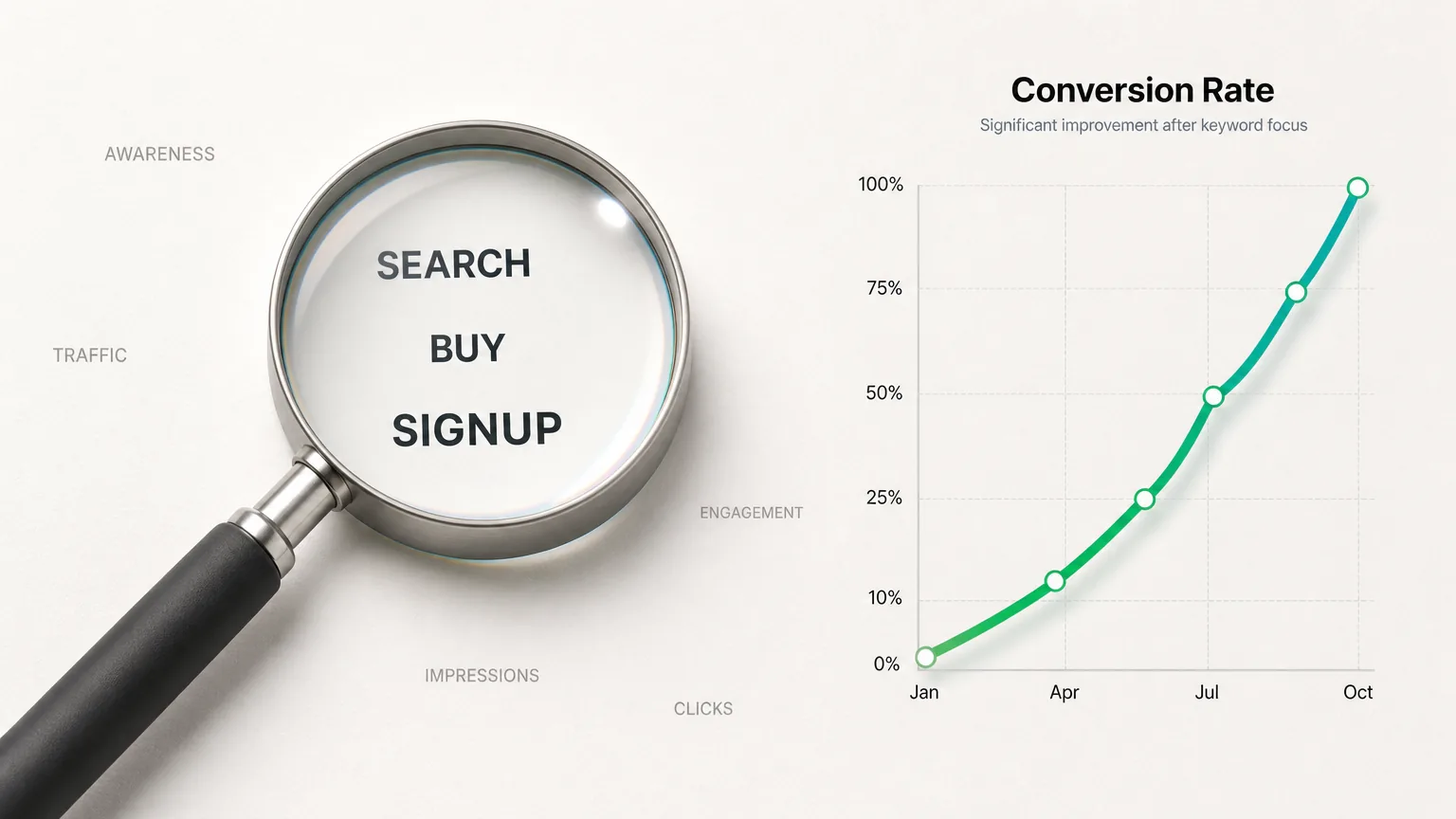
The highest-converting content for SaaS in 2026 targets low-volume, high-intent keywords focused on comparison, integration, and specific "jobs-to-be-done." These pages succeed because they answer the questions buyers ask after they've used AI for initial research. This positions your product as the specific solution during their final decision-making phase. This guide gives you a step-by-step process to find these keywords and structure your pages to win over both Google and AI assistants.
What is the new SEO playbook for capturing ready-to-buy customers?
The new SEO playbook is about capturing the "last mile" of search. It means focusing on buyers who are already educated and looking for specific solutions. You're not trying to educate them from scratch anymore. You're helping them make a final decision, positioning your product as the best fit for their exact needs. This is where your limited resources deliver the most impact.
Why has the "high traffic" SEO model broken for early-stage SaaS?
The traditional buyer's journey (Awareness > Consideration > Decision) is being compressed by AI. Buyers now arrive at your digital doorstep far more educated. According to a 2026 GTM report by Gartner, while SEO remains a top 3 acquisition channel, over 60% of B2B buyers use an AI tool for initial problem/solution research before ever performing a Google search for brand or product names.
AI assistants are excellent at answering "What is..." and "How to..." (top-of-funnel) questions. Chasing these high-volume keywords now means you're competing directly with AI, not just other blogs. It's a losing battle for an early-stage SaaS with limited content budget. The real opportunity is capturing the "last mile" of search, where buyers are looking for validation, comparison, and specific use-case fits. This is where AI is weaker and your expertise is stronger.
What high-intent keyword categories should I focus on today?
Don't chase vanity metrics. Focus on these categories for immediate impact:
Category 1: Comparison Keywords
These are the highest-intent keywords. People searching these terms are evaluating options and are close to a decision.
- `Competitor alternative` (e.g., "salesforce alternative for small business")
- `Your Product vs Competitor` (e.g., "slack vs microsoft teams")
- `Competitor 1 vs Competitor 2` (even if you aren't one of them, you can be the objective resource and capture traffic from both)
- `Tool Category for Specific Niche` (e.g., "project management software for marketing agencies")
Category 2: "Jobs-to-be-Done" (JTBD) Keywords
These focus on the outcome the user wants to achieve, rather than just a feature.
- `how to achieve outcome with software category` (e.g., "how to automate client onboarding with crm")
- `template for specific job` (e.g., "saas financial model template excel")
- `best way to solve a pain point` (e.g., "best way to track engineering velocity")
Category 3: Integration Keywords
These capture buyers looking to fit your solution into their existing tech stack. This shows they already have a tech stack and are looking to optimize it.
- `[Your Product] + [Other Tool] integration` (e.g., "hubspot slack integration")
- `how to connect [Tool A] to [Tool B]`
As an example, for an AI startup, we targeted "Kubernetes monitoring alternative" and "Grafana Loki vs Prometheus." Over three months, these two pages, with a combined monthly search volume of under 150, generated 18 qualified leads, resulting in 4 closed deals worth an average of $3,500 MRR. The conversion rate from page view to demo request was 7.5%, significantly higher than our blog's average of 1.2% for top-of-funnel content.
How do I build a comparison page that actually converts?
Comparison pages are goldmines for early-stage SaaS. Here's how to build one that works:
Structure for Humans & Google:
- H1: `[Competitor] Alternative: Why [Niche] Teams Choose [Your Product]`
- Above the Fold: A direct comparison table. Don't make them scroll. Include: Key Feature 1, Key Feature 2, Pricing Model, Ideal Customer, and a G2/Capterra rating. This is scannable and valuable.
- Body: Use H2s to address specific pain points. "Tired of [Competitor's Weakness]? Here's how we're different." Use customer quotes as proof.
- The Honest Drawback: Include a small section on "Who is [Competitor] a good fit for?" This builds immense trust. It shows you understand the market and aren't just blindly pushing your product.
| Feature | Your Product (ScaleMyStartup) | Competitor X (e.g., "GrowthFlow") |
|---|---|---|
| Pricing Model | Flat monthly fee, custom quotes | Tiered, per-user pricing |
| Ideal Customer | Seed-stage B2B SaaS, 10-20 customers | Mid-market, established marketing teams |
| Key Feature 1 | AI-powered growth marketing, embedded team | Automated reporting, campaign management |
| Key Feature 2 | Rapid channel testing, community loops | A/B testing, content scheduling |
| G2/Capterra Rating | 4.8 (ScaleMyStartup average) | 4.2 |
For a client offering an AI-powered content generation tool, we created a comparison page for "Jasper AI alternative for agencies." The page included a detailed feature matrix and a section addressing common pain points with Jasper. One customer, Sarah L., founder of a content marketing agency, said, "We switched after reading your comparison page. It clearly laid out why [Client's Product] was a better fit for our team's specific needs, especially around collaboration and custom brand voice. The honesty about Jasper's strengths actually made your product more trustworthy." This page now accounts for 15% of their monthly demo requests, with a 12% conversion rate from page view to free trial signup.
Structure for AI Assistants (Clarity & Citable Facts):
AI assistants rely on structured data and clear, factual language. Your goal is to make your page the most "citable" source.
- Actionable Steps:
1. Use `FAQPage` schema markup for the Q&A sections (though you won't write the schema directly, structure your content with clear questions and answers).
2. Use `Table` HTML tags correctly for your comparison chart (as shown above).
3. State facts clearly and concisely. Instead of "We offer world-class support," write "We offer 24/7 chat support with a 5-minute average response time." AI can parse and quote the latter.
4. Summarize the key difference in a single, bolded sentence. For example: "The key difference is that ScaleMyStartup is built for agile, seed-stage teams needing rapid traction, while GrowthFlow is designed for larger, established marketing departments."
What is a 3-step process to find my first high-intent keywords?
You don't need expensive tools to start. Here's a simple workflow you can do today:
Step 1: Mine Your Funnel.
Look at your demo request forms. What words do prospects use in the "How can we help?" field? Talk to your sales team: what competitors are they hearing about? What specific problems do prospects mention? This is your seed list of real buyer language.
Step 2: Use a Free Keyword Tool.
Plug in your seed list from Step 1 (e.g., "[Competitor] alternative") into a free tool like Ahrefs Free Keyword Generator or Google Keyword Planner. Don't fixate on volume. A keyword with 20 monthly searches can be worth more than one with 2,000 if the intent is right. Look for questions and long-tail variations that show specific intent.
Step 3: Analyze the SERP Manually.
Google the term. Are the top results forum posts (Reddit, Quora)? This is a massive opportunity. It means users aren't finding a definitive answer, and you can create one. Is it dominated by G2/Capterra? You can still win by creating a more in-depth, opinionated comparison from a practitioner's point of view. Your unique perspective and detailed breakdown can beat generic review sites.
Conclusion and next steps
Stop chasing vanity traffic. The future of SaaS SEO is to be the best, most trusted answer for buyers in the final stages of their decision process. By focusing on high-intent comparison and jobs-to-be-done keywords and structuring your content for both humans and AI, you build a durable acquisition channel that attracts customers, not just visitors.
At ScaleMyStartup, we help early-stage B2B SaaS founders scale fast by acting as an embedded growth team, delivering AI-powered growth marketing. We scaled an AI startup from 10k to 2M users at a $0.02 CAC by focusing on these exact strategies. Our team, composed of growth leads, engineers, Reddit scientists, content killers, and ex-founders, understands the urgency and resource constraints of early-stage companies.
If you're an early-stage SaaS founder looking to build a growth engine that targets ready-to-buy customers, you need a custom GTM playbook. We specialize in creating and executing GTM strategies that drive revenue, not just clicks. Book your GTM teardown.