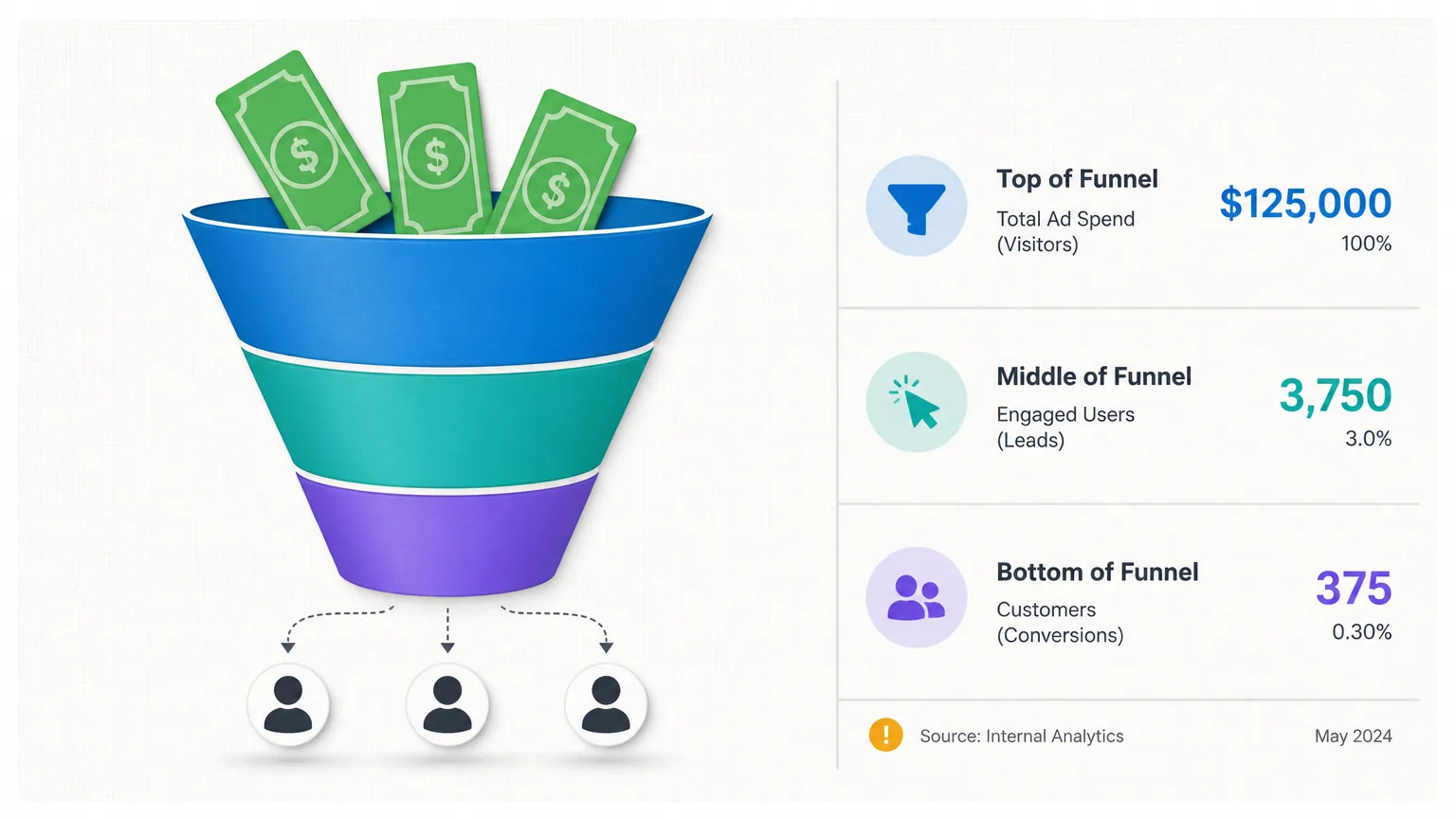
Performance marketing for your SaaS startup means you pay for specific, measurable actions, such as a free trial sign-up or a demo request. Unlike brand marketing, which builds general awareness, performance marketing ties every dollar spent directly to a tangible result, making it ideal for early-stage B2B SaaS startups focused on rapid user acquisition.
Why should my SaaS startup care about performance marketing?

As a founder, your runway is finite, and every dollar needs to work hard. Performance marketing isn't just an expense, it's a growth engine you can control. Here's why it matters for your early-stage SaaS:
1. Directly measurable ROI: You can connect your ad spend directly to new trials, demos, and ultimately, your Monthly Recurring Revenue (MRR). No guessing games, just hard numbers.
2. Scalability: Once you find a channel that profitably acquires customers, you can increase your budget and scale your customer acquisition predictably.
3. Data and insights: Every campaign is a learning opportunity. You'll learn exactly what messaging resonates, which offers convert, and who your most valuable audiences are. This data informs not just your marketing, but your product and sales strategy too.
What are the key performance marketing channels for a B2B SaaS?
You don't need to be everywhere. Focus on channels where your Ideal Customer Profile (ICP) spends their time and, more importantly, where they're looking for solutions.
Paid search (Google and Bing Ads): How do I capture high-intent users?
Paid search is about capturing users who are actively looking for a solution like yours right now. Think of it as putting your product in front of someone who just typed "best CRM for small businesses" into Google.
- Strategy: Bid on keywords that indicate high intent. This includes problem-based keywords ("project management software for remote teams"), competitor names (if your product offers a clear advantage), and branded terms (once you have some traction).
- Value: These users are often "bottom-of-funnel," meaning they're close to making a purchase decision. The cost per click can be higher, but the conversion rates are often worth it.
Paid social (LinkedIn and Facebook/Instagram): How do I reach my ideal customer profile?
Paid social lets you proactively reach your ICP, even if they aren't actively searching for you yet.
- LinkedIn: This is the premier B2B social ad platform. You can target by job title, company size, industry, seniority, and even specific skills. If your ICP is a Head of Marketing at a 50-person tech company, LinkedIn lets you find them.
- Facebook/Instagram: Don't dismiss these. While often seen as B2C, they can be a cheaper option for reaching specific professional communities or roles. If your ICP follows certain industry thought leaders or belongs to niche professional groups, you might find them here. Look for interest-based targeting that aligns with their professional lives.
SaaS marketplaces (Capterra, G2): How do I get in front of buyers comparing software?
These platforms are where buyers go when they're in the final stages of evaluating software. They're comparing features, reading reviews, and looking at pricing.
- Value: Users on these sites are high-intent and often high-converting. They've already identified a need and are looking for the best fit.
- Consideration: These can be high-cost channels, often operating on a pay-per-lead or pay-per-click model, but the quality of the lead can justify the expense.
What about other channels like affiliate or content syndication?
These are more advanced strategies. Consider them once your core paid search and social channels are optimized and generating predictable results. They require more setup and management, so focus your limited resources on what moves the needle fastest first.
How do I set up my first performance marketing campaign?
Don't overcomplicate your first campaign. Start small, learn fast, and iterate.
Step 1: What is my goal and what am I paying for?
Before you spend a dollar, define your "performance" metric. Is it a free trial sign-up, a demo request, or a whitepaper download? This is your primary conversion goal. For a SaaS, a trial or demo request is usually the most impactful.
Step 2: Who am I targeting?
Revisit your Ideal Customer Profile. Who exactly are you trying to reach? What are their pain points? What job title do they hold? The more specific you are, the better your targeting will be.
Step 3: What is my offer and my landing page?
Your ad needs a clear offer, and that offer needs a dedicated landing page. Sending paid traffic to your homepage is one of the most common and costly mistakes. Your landing page should have a single, clear call-to-action that directly matches the ad's promise. Make it easy for them to convert.
Step 4: How do I set a realistic starting budget?
For an early-stage founder, start with enough to get statistically significant data. Aim for enough budget to get 50-100 clicks to your target action. This might mean $500-$2,000 per month for a single channel, depending on your Cost Per Click (CPC). Don't expect miracles with $100.
Step 5: How do I track everything?
Without tracking, you're flying blind. You must have proper conversion tracking in place before spending any money. Use tools like Google Analytics, Google Tag Manager, and the platform-specific pixels (e.g., Google Ads conversion tracking, LinkedIn Insight Tag) to measure every step of the user journey.
What SaaS metrics should I use to measure success?
Connect your ad spend to your core business metrics. These tell you if your performance marketing is actually driving growth, not just traffic.
- Cost Per Acquisition (CAC): This is the total cost to acquire one new paying customer. This includes your ad spend, agency fees (if any), and any other related marketing costs.
- Lead-to-Trial/Demo Rate: This measures the percentage of people who click your ad and complete your desired action (e.g., sign up for a trial or request a demo). A low rate here means your ad or landing page needs work.
- Customer Lifetime Value (LTV) to CAC Ratio: The ultimate measure of profitability. A good LTV:CAC ratio for a healthy SaaS business is 3:1 or higher. This means for every dollar you spend acquiring a customer, you're getting at least three dollars back over their lifetime.
- Payback Period: How many months it takes to recoup your CAC from a new customer's subscription revenue. For early-stage SaaS, aiming for a payback period under 12 months is a good benchmark.
> Work with ScaleMyStartup
>
What are the most common mistakes SaaS startups make?
I've seen these mistakes too many times. Avoid them to save your limited time and budget.
- Mistake 1: Sending traffic to the homepage instead of a dedicated landing page. Your homepage serves many purposes. Your ad's landing page should serve one: converting the click into your desired action.
- Mistake 2: Not having proper conversion tracking in place before spending. This is like driving without a speedometer. You have no idea if you're making progress or just burning fuel.
- Mistake 3: Giving up too early before a campaign has enough data to be optimized. Performance marketing requires testing and iteration. Don't stop after $100 of spend and zero conversions. You need enough data to make informed decisions.
- Mistake 4: Targeting too broad of an audience. You're trying to find your first few paying customers, not every business on the planet. Be hyper-specific with your targeting.
Should I do this myself or hire a growth accelerator?
This strategic decision depends on your budget and how much time and expertise you have internally.
- DIY approach: If your budget is very small (under $2,000 per month) and you have the time and desire to learn the fundamentals, doing it yourself is a valid path. You'll gain invaluable firsthand knowledge. However, be prepared for a steep learning curve and potential wasted spend on mistakes.
- Hire a growth accelerator: This is the right choice when you have a validated offer, a budget to invest, and lack the in-house time or expertise to manage and scale campaigns effectively. ScaleMyStartup acts as an embedded growth team, providing AI-powered growth marketing to identify scalable channels, test rapidly, and build user traction. They work with a maximum of 3 startups at a time.
Performance marketing is a powerful, controllable engine for SaaS growth when done correctly. It requires data, continuous testing, and a clear understanding of your customer. You should start small, track everything, and iterate based on the results.
Ready to build a performance marketing engine for your SaaS? ScaleMyStartup helps early-stage B2B SaaS founders scale fast. Book a free growth strategy call.