
How to Scale a B2B SaaS Company with a Limited Marketing Budget
Scaling a B2B SaaS company with a limited marketing budget requires a shift from expensive paid channels to high-leverage, organic tactics. Focus on identifying one scalable channel through rapid experimentation, leveraging product-led growth, and creating community loops. The key is disciplined execution on low-cost, high-signal activities like targeted content, community engagement, and engineering-as-marketing.
The budget-constrained founder's dilemma
You've built a solid B2B SaaS product. Your early users love it. But now you're stuck. You've hit that 100-user plateau, and traditional marketing feels like a black hole for your remaining seed capital. You know a great product isn't enough, but the typical marketing playbook, big ad spends, large teams, long campaigns, is too slow and expensive for an early-stage startup in 2026.
There's pressure, whether it's to hit that next funding milestone or simply to reach profitability before you run out of runway. You've tried a few things, maybe some LinkedIn outreach or basic content, but the results aren't compounding. You're tired of random tactics that don't move the needle, especially after spending money on ads that didn't work last year.
Shifting your mindset: from spending to executing
The common advice for growth often assumes you have a war chest. It suggests hiring bloated marketing teams, pouring money into broad ad campaigns, and waiting months for results. That's not your reality. Your reality demands a lean execution approach.
Your most valuable assets right now are speed and the ability to test rapidly. You can't outspend the competition, but you can out-experiment them. This means moving away from the "spray and pray" mentality and embracing a focused, data-driven approach to discover what actually works for your specific audience. At ScaleMyStartup, we work with founders who ship fast, think like students, and experiment like mad scientists. This mindset is crucial for turning limited resources into significant traction.
The 7 most effective low-budget scaling strategies
1. Find your one scalable channel
Many founders spread their limited resources across too many channels, getting minimal results from each. The smarter move is to focus all your energy on identifying and then dominating one truly scalable channel. This doesn't mean ignoring all other channels forever, but it means dedicated, deep effort until you crack one.
How do you find it? You run rapid, time-boxed experiments. Pick 3-4 potential channels that align with your target audience. Allocate a small, fixed budget and a short timeframe (e.g., 2-4 weeks) to each. Define clear success metrics upfront: X number of qualified leads, Y conversions, Z user sign-ups. If a channel doesn't show promising signals within that time, cut it and move on. Don't fall in love with a channel, fall in love with the results. At ScaleMyStartup, we embed with our clients to run these rapid experiments, because speed is the most critical factor. We’ve seen this focus scale companies to millions of users.
2. Master product-led growth (PLG)
Product-led growth means using your product itself as the primary engine for acquisition, conversion, and expansion. It's about designing your SaaS so that users can discover its value quickly and easily, often without needing to talk to sales.
Think freemium tiers that offer real value, interactive demos that showcase core features, or viral mechanics like referral programs built directly into the product. When your product sells itself, your marketing costs drop dramatically. According to OpenView, PLG companies are valued over 30% more than their peers. This isn't just about saving money; it's about building a fundamentally more efficient and valuable business.
3. Turn founders into AI-powered content machines
Hiring a full content team is expensive. Waiting months for SEO results can feel like an eternity. But in 2026, new AI tools have dramatically lowered the barrier to entry for high-quality, targeted content creation. A founder, armed with the right AI tools and a clear strategy, can produce content that competes with larger teams.
Start by identifying your core customer pain points. Create pillar content, in-depth guides, case studies, or thought leadership pieces, that directly address these. Then, use AI to atomize that content: pull out key statistics for social media posts, generate short video scripts, or craft email snippets. The goal is to create content that drives real traction, not just vanity metrics. We have a playbook for turning founders into AI content machines, helping them create content that drives real traction, not just vanity metrics.
4. Build community loops on platforms like Reddit
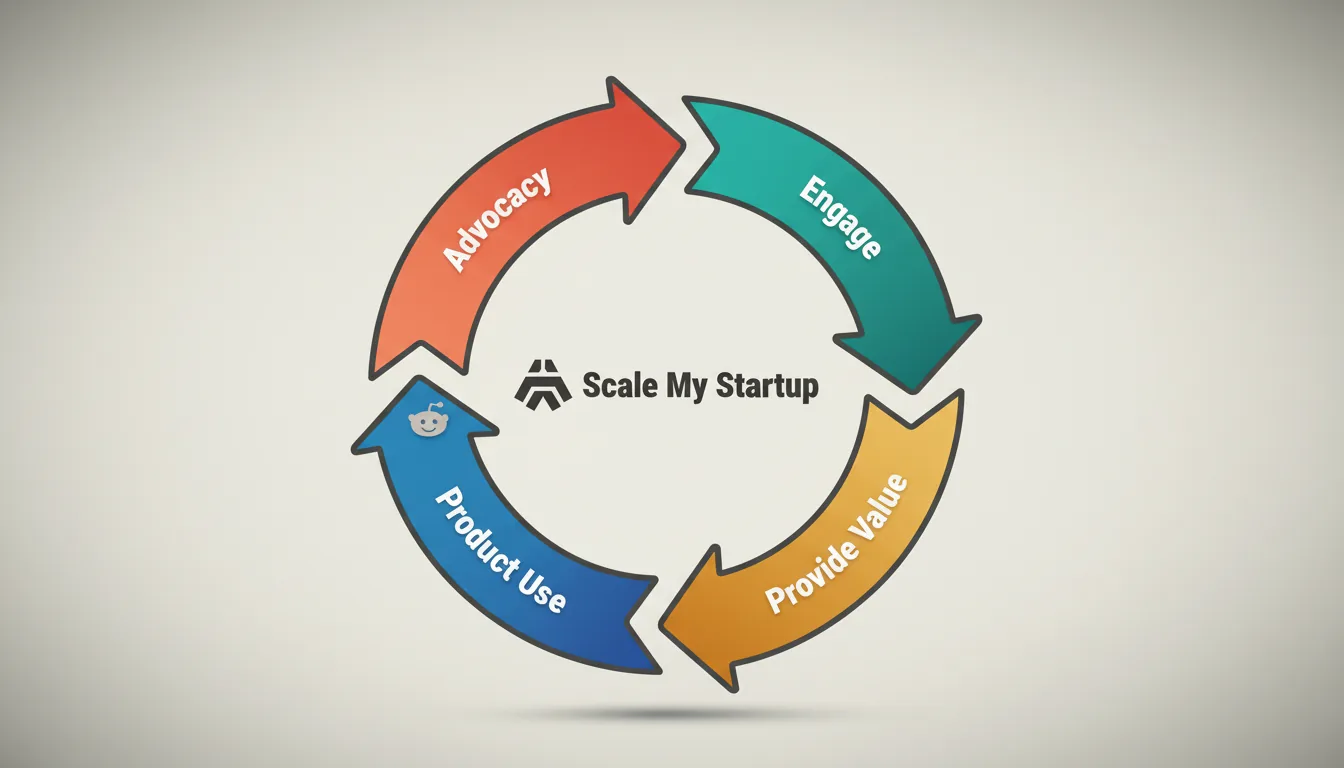
Community loops are a powerful, low-cost growth mechanism. It works like this: you engage authentically in online communities where your target audience hangs out, provide genuine value, gently guide interested users to your product, and then those users become advocates who return to the community, reinforcing the loop.
Reddit is a prime example. It requires a "Reddit scientist" approach: identify relevant subreddits, spend time understanding the culture and common problems, and contribute meaningfully. Only mention your product when it directly solves a problem being discussed, and always prioritize helping over selling. This builds trust and authority. Our team includes "Reddit scientists" who specialize in this. Using community loops, we helped one AI startup grow from 10k to 2M users.
5. Leverage engineering-as-marketing
Engineering-as-marketing means building free, useful tools that solve a small, specific problem for your target audience. These tools act as lead magnets, generating awareness and authority for your main product.
Think of HubSpot's Website Grader, which analyzes website performance, or CoSchedule's Headline Analyzer, which helps with content optimization. These aren't your core product, but they demonstrate your expertise and attract your ideal customer. They're valuable enough to share, often go viral in niche communities, and provide a soft entry point to your brand, all without direct ad spend.
6. Use short-form video ads surgically
The idea that all paid advertising is expensive is outdated. While broad campaigns can burn cash fast, hyper-targeted, low-budget short-form video ads on platforms like TikTok, Reels, and YouTube Shorts can be incredibly effective for early-stage B2B SaaS.
The key is "surgical" use. Don't aim for massive reach initially. Focus on testing specific messaging, value propositions, and calls to action with small, highly defined audiences. These platforms allow for rapid iteration and surprisingly low CPMs if your creative is engaging and authentic. This isn't about scaling paid ads immediately, but about using them as a rapid feedback loop for what resonates. Creating effective short-form video ads is part of our GAAS (Growth as a Service) offering.
7. The "Embedded Growth Team" model
For many founders, the choice is between hiring an expensive full-time growth lead (who may not have all the skills you need) or an agency that feels distant and slow. There's a third option: an embedded, fractional growth team.
This model provides specialized expertise, growth hackers, engineers, content creators, on-demand, without the overhead of full-time hires or the detachment of a traditional agency. It's like having a growth co-founder and their team, but without the equity hit or the long-term salary commitment. As a private growth accelerator, we act as an Embedded Growth Team for a maximum of 3 startups at a time. We integrate directly into their Slack, functioning as their in-house team to drive traction. We've seen this model help companies like the AI startup we scaled from 10k to 2M users at a $0.02 CAC.
> Work with ScaleMyStartup
>
Comparing growth options for lean B2B SaaS
Choosing the right growth partner or strategy is critical when every dollar counts. Here's a breakdown of common approaches:
| Approach | Typical Cost | Speed to Result | Expertise Level |
|---|---|---|---|
| Hiring a Full-Time Growth Lead | High (salary, benefits, overhead: $10k-25k+/month) | Medium (ramp-up time 3-6 months) | Variable (depends on individual hire) |
| Traditional Marketing Agency | Medium to High ($5k-20k+/month retainer) | Slow (often focused on long-term campaigns) | Broad, but often generalist |
| Hiring Freelancers | Low to Medium ($500-5k+/project or monthly) | Medium (depends on quality and management) | Specific, but siloed |
| DIY Founder-Led Growth | Very Low (time, tools) | Variable (steep learning curve) | Founder's existing skills |
| Embedded Growth Team (GAAS) | Medium (fractional cost, high impact) | Fast (weeks to initial traction) | High (specialized, integrated) |
FAQ: Scaling B2B SaaS on a Budget
How much should a B2B SaaS startup spend on marketing?
For early-stage B2B SaaS with a limited budget, focus less on a fixed percentage and more on proving a scalable channel. Your initial spend should be on rapid experimentation to find what works, typically ranging from $1,000 to $5,000 per experiment, rather than a large, sustained budget. Once a channel is proven, you can scale spend based on positive ROI.
What is the single most important metric to track when scaling with a limited budget?
Customer Acquisition Cost (CAC) and CAC Payback Period are critical. With limited funds, you need to know exactly how much it costs to acquire a customer and how quickly they become profitable. A low CAC and a short payback period (ideally under 6-12 months for early-stage SaaS) indicate a sustainable growth engine.
How long does it take to see traction from content marketing?
True traction from content marketing, especially for SEO, can take 6 to 12 months to build significant organic traffic. However, you can see earlier signals of success, like increased engagement, social shares, and direct leads, within 2-4 months if your content directly addresses pain points and is distributed effectively in communities.
Is paid advertising ever a good idea for a bootstrapped SaaS?
Yes, but surgically. Avoid large-scale brand awareness campaigns. Instead, use paid ads for hyper-targeted experiments to validate messaging, test offers, or drive initial sign-ups for a product-led growth motion. Think small budgets ($500-2,000) over short periods (2-4 weeks) to prove an ROI before scaling.
What is "Growth as a Service" (GAAS)?
Growth as a Service (GAAS) is a model where an external team acts as an embedded, fractional growth department for your startup. Instead of hiring full-time or using a traditional agency, you get access to a multidisciplinary team of growth experts (hackers, engineers, content specialists) who integrate directly into your operations to drive user acquisition and revenue.
Tired of guessing? We help founders build scalable growth engines. See how we do it.