You've built a solid SaaS product, maybe even landed a few early customers. Now comes the hard part: getting more of them, predictably, without burning through your runway. This is where a growth marketing agency comes in, but not just any agency. You need a partner who understands the unique challenges of early-stage B2B SaaS, not a generalist trying to sell you a one-size-fits-all solution.
This page will give you a clear framework for evaluating and choosing the right growth partner for your specific stage, so you can invest with confidence.
What does a growth marketing agency actually do for a SaaS startup?
A growth marketing agency for a SaaS startup goes beyond just "running ads" or managing social media. Think of them as outsourced "growth scientists" for your startup. Their job is to help you build the machine that brings you customers, focusing on the entire funnel, not just the top.
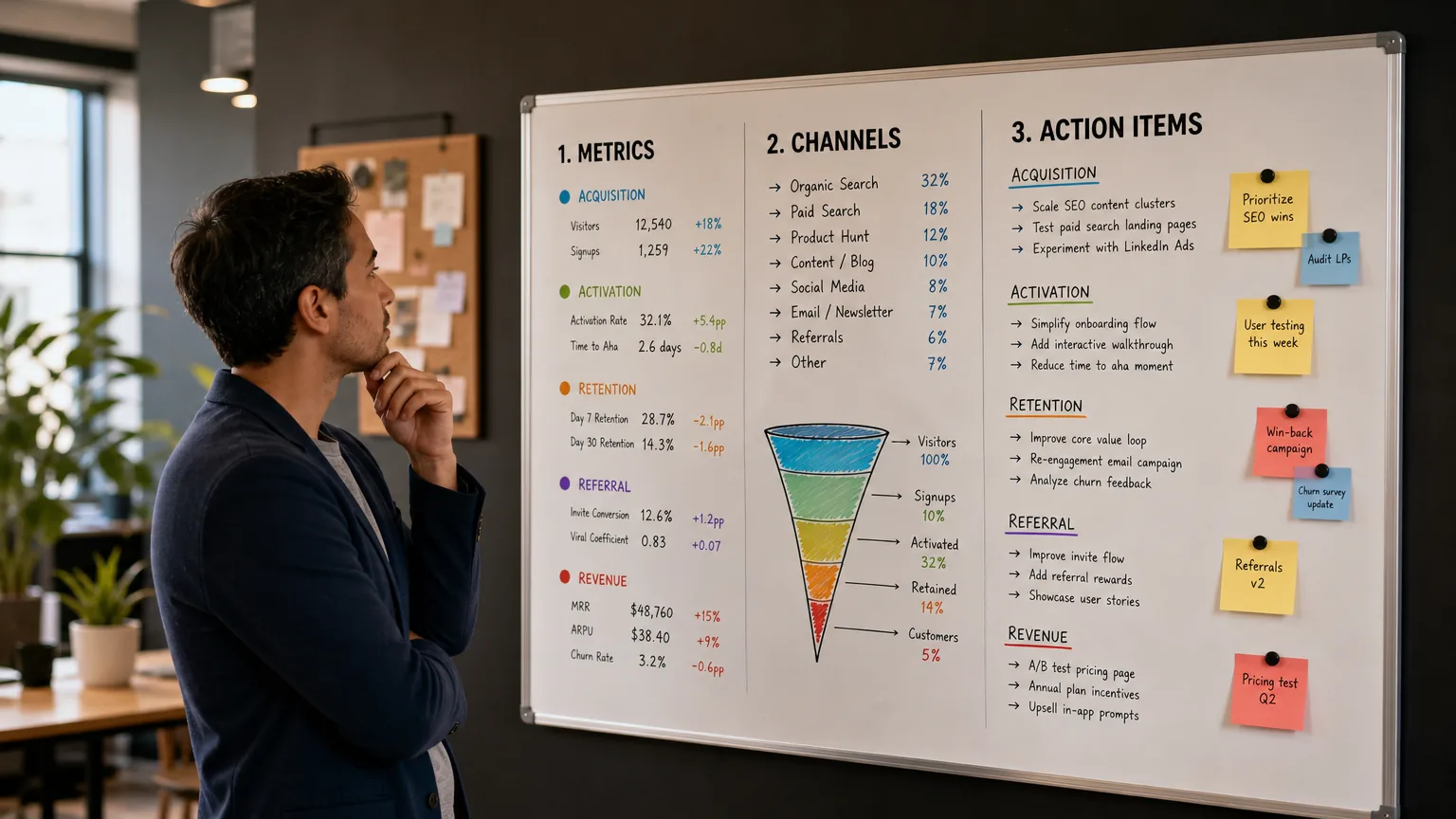
They focus on the full AARRR (Acquisition, Activation, Retention, Referral, Revenue) funnel. Their core process looks like this:
1. Data Analysis: They dig into your current data, or help you set up tracking if you don't have it, to understand where users are dropping off or what's working.
2. Hypothesis Generation: Based on data, they form specific, testable ideas about how to improve a key metric (e.g., "If we change our landing page headline to X, we'll see a 15% increase in sign-ups").
3. High-Tempo Experimentation: They design and run small, focused experiments across various channels (paid ads, content, email, outbound, product changes) to test these hypotheses quickly. We're talking 10-15 experiments a month, not one big campaign.
4. Learning & Iteration: They analyze the results, learn what worked and what didn't, and use those insights to inform the next round of experiments. This continuous loop is how you find scalable channels.
The goal isn't just traffic; it's finding repeatable channels that drive actual revenue and user growth.
How is a growth agency different from a traditional digital marketing agency?
This is a critical distinction for early-stage SaaS founders. A traditional agency might be great for brand building or specific channel execution, but a growth agency is wired differently.
| Factor | Traditional Agency | Growth Agency |
|---|---|---|
| Goal | Brand awareness, leads, specific channel performance | Scalable revenue growth, finding repeatable acquisition |
| Scope | Often top-of-funnel channels (SEO, Ads, Social) | Full funnel (Acquisition, Activation, Retention, Revenue) |
| Process | Campaign-based, project-driven, content creation | Experimentation loop, data-driven hypotheses, rapid testing |
| Metrics | MQLs, traffic, impressions, clicks, engagement | MRR, LTV, CAC, activation rate, retention rate |
| Team Structure | Channel specialists (e.g., SEO expert, PPC manager) | T-shaped marketers, cross-functional, strategic partners |
A traditional agency might focus on getting you 1,000 marketing qualified leads (MQLs). A growth agency will ask, "How many of those MQLs convert to paying customers, what's their LTV, and what's the CAC?" The right agency focuses on business metrics like MRR and CAC, not vanity metrics like traffic or impressions.
What are the 5 non-negotiable traits of a great SaaS growth agency?
When you're putting your limited runway on the line, you need a partner with specific qualities.
1. Do they have a documented growth process?
They should be able to clearly articulate their experimentation framework. Ask them to walk you through how they go from an idea to a tested outcome. If it's just "we'll try some stuff," that's a red flag. A good process means they have a system for hypothesis generation, experiment design, execution, and analysis. This structured approach is how they find what works, rather than just throwing money at channels.
2. Are they data-obsessed and tool-agnostic?
They should care more about your business metrics than vanity metrics from a specific tool. They should be asking about your current analytics setup, your CRM, and how you track user behavior. They should also be flexible with tools, using whatever best serves the experiment, not just pushing their preferred platform. If they're leading with "we're experts in X ad platform," they might be too channel-focused.
3. Do they have deep, provable experience with early-stage B2B SaaS?
Specialization matters. E-commerce or enterprise growth is a different game. The sales cycles, unit economics, and product-led growth strategies for early-stage B2B SaaS are unique. Ask for SaaS-specific case studies. If their examples are all about consumer apps or large corporations, they might not understand your specific challenges like finding your first 50 paying customers or proving product-market fit.
4. Is their team composed of T-shaped marketers?
A T-shaped marketer has a broad understanding of the full funnel (the horizontal bar of the 'T') and deep expertise in one or two specific areas (the vertical bar). This means they can see the whole picture, identify bottlenecks, and then dive deep into executing specific experiments. You need people who can connect the dots between an ad click and a retained user, not just siloed specialists who only care about their one channel.
5. Do they function like a partner, not a vendor?
A true growth agency for a SaaS startup is a strategic partner, not just a channel manager. They should challenge your assumptions, be transparent with failures, and integrate with your team. This means regular communication, shared goals, and a willingness to adapt as learnings come in. If they're just taking orders and sending reports, they're a vendor, and that's not what an early-stage founder needs.
What red flags should you watch out for?
Not every agency is the right fit, and some are just bad news. Here are some warnings:
- The "Guaranteed Results" Promise: Growth is about experimentation; there are no guarantees, only a process to find what works. If someone promises you "guaranteed 2x MRR in 90 days," run the other way. They're either lying or don't understand how early-stage growth works.
- The "Secret Sauce" or "Proprietary Method": A good agency is transparent about their process. If they can't explain how they'll approach your growth without resorting to buzzwords or claiming a "secret formula," they likely don't have a solid process.
- The Long-Term, Inflexible Contract: Early-stage growth requires agility. You need to be able to pivot quickly. Look for initial commitments of 3-6 months, not 12-month lock-ins. You need to see tangible progress within a quarter.
- The Bait-and-Switch: The senior person who sells you the contract is not the junior person who does the work. Ask who will be on your account day-to-day, what their experience is, and how you'll communicate with them.
- Focus on Vanity Metrics: If their reports lead with "impressions" or "clicks" instead of signups, activations, or MRR, be wary. These metrics don't pay the bills. Your goal is to find customers, not just eyeballs.
How does ScaleMyStartup work with early-stage SaaS founders?
We built ScaleMyStartup specifically for founders like you: early-stage B2B SaaS companies looking for predictable customer acquisition without burning through cash.
Our Process: We use a rigorous 4-step Growth Sprint: Research -> Hypothesize -> Experiment -> Analyze. This isn't theoretical; it's a high-tempo, data-driven loop designed to find your scalable channels fast. We run multiple experiments every month, learning and iterating with you.
Our Focus: We only work with early-stage B2B SaaS companies. We don't do e-commerce. We don't do enterprise. This specialization is our superpower. Our entire process is built for the unique challenges of early-stage SaaS: limited budget, the need for speed, and the hunt for product-market fit. We understand the B2B sales cycle, unit economics, and product-led growth.
Our Team: Our team is composed of T-shaped marketers, engineers, and ex-founders. We embed directly into your Slack channels, acting as an extension of your team. We challenge your assumptions and celebrate successes and failures transparently. Our goal is to build a growth engine that eventually you can take in-house.
Our Partnership Model: We typically start with a 90-day Growth Foundation sprint. This allows us to rapidly test channels, establish baseline metrics, and identify your first few scalable acquisition paths. We work with a maximum of 3 startups at a time to ensure deep focus.
What results can you expect?
We don't guarantee specific outcomes, because growth is an iterative process. What we do guarantee is a disciplined, data-driven approach focused on finding what works for your product. Our goal is to establish a predictable acquisition engine and demonstrate clear ROI.
Here are a few examples of what we've helped founders achieve:
- Client: A small AI-powered sales enablement tool.
- Challenge: They had a great product but no repeatable way to get new users beyond founder-led sales.
- Our Work: We ran 15 experiments in 90 days, testing LinkedIn outreach, targeted cold email, and niche community engagement. We discovered that a specific LinkedIn outreach sequence combined with a product-led onboarding flow was the most scalable channel.
- The Result: Grew qualified demos by 300% in 3 months and established their first predictable acquisition channel, moving from 4 to 16 qualified calls a month on a $3,000 monthly spend.
- Client: A new developer tool SaaS for data visualization.
- Challenge: Zero organic signups after launch; founders were unsure which marketing channels would resonate.
- Our Work: We focused on community loops via Reddit and targeted content marketing. We identified key subreddits and created short-form video ads demonstrating the product's unique value.
- The Result: Achieved 200 new sign-ups in 6 weeks, with a CAC of $12 for qualified users, giving them the traction needed for their next funding round.
You need a partner who understands your journey. If you're ready to stop guessing and start building a growth machine, let's talk.
Book a Free Growth Strategy Call to discuss your specific challenges and see if we're a mutual fit. We'll map out potential growth levers for your SaaS, no obligation.