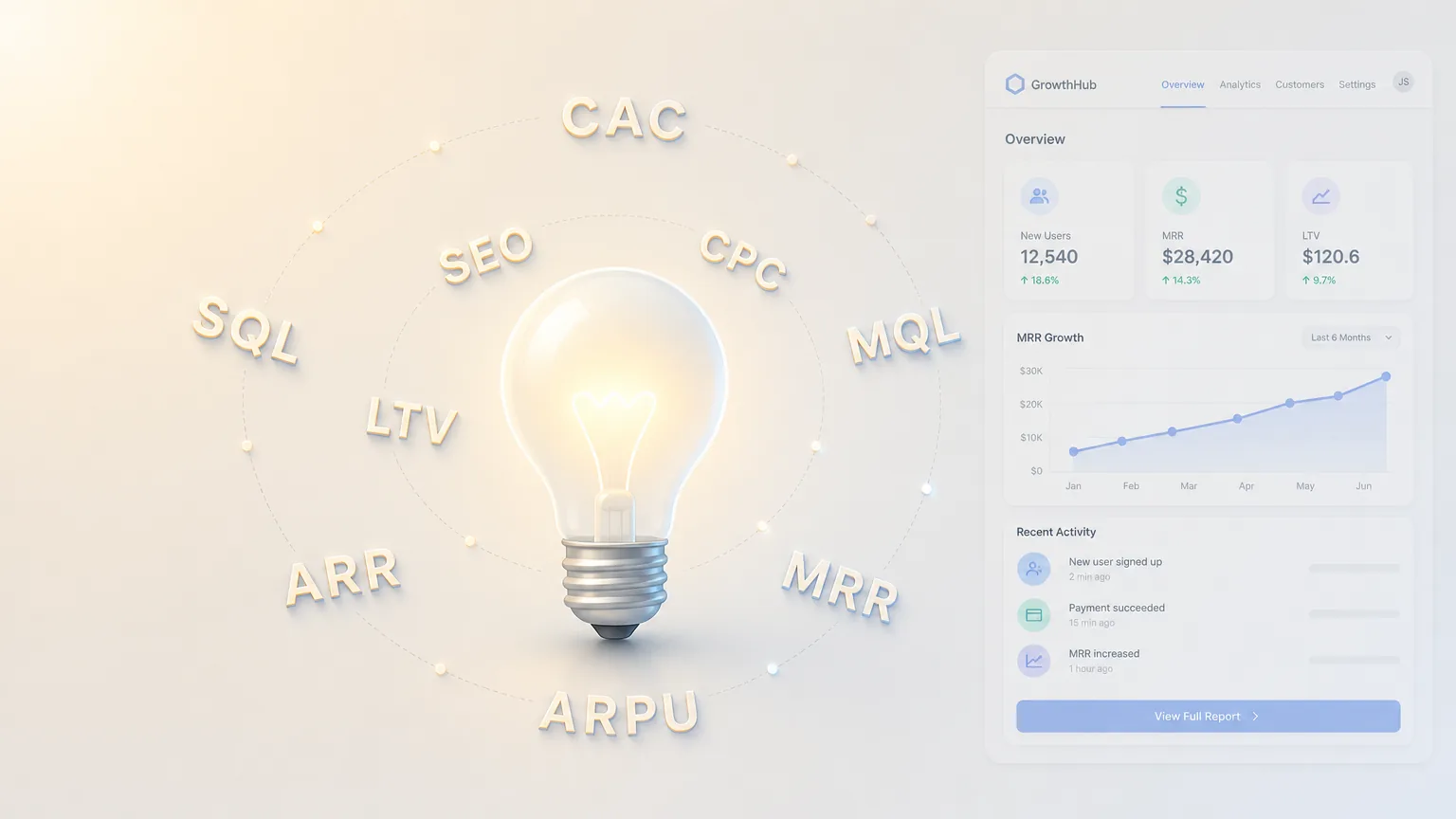
Why is this marketing jargon so confusing (and important)?
Let's be honest: the world of B2B SaaS growth marketing often feels like a secret club with its own language. Acronyms fly around, and technical terms can make your head spin, especially when you're an expert in your product, not necessarily in marketing. This jargon isn't just annoying; it can be a real barrier to understanding what's working, what's not, and who to trust when you're looking for help.
The good news is, you don't need to become a marketing academic. You just need a practical, no-fluff guide to the essential terms. Understanding this vocabulary is the first step to measuring what truly matters for your startup and hiring the right growth partner. This guide will demystify the conversation, giving you the confidence to talk growth like a pro.
What are the essential B2B SaaS growth terms from A to Z?
Here's your quick reference for the key terms you'll encounter in B2B SaaS growth marketing in 2026.
A/B Testing
Definition: A method of comparing two versions of a webpage or app against each other to determine which one performs better.
Example: We can test if a green or a blue 'Sign Up' button gets more clicks.
Learn More: Conversion Rate Optimization
ARR (Annual Recurring Revenue)
Definition: The predictable revenue a SaaS business can expect to receive from its customers over one year.
Example: With 100 customers paying $1,200 a year, our ARR is $120,000.
Learn More: SaaS Metrics
CAC (Customer Acquisition Cost)
Definition: The total cost of sales and marketing to acquire a single new customer.
Example: If we spent $5,000 on ads and got 10 customers, our CAC is $500.
Learn More: SaaS Metrics
Churn Rate
Definition: The percentage of customers who cancel their subscriptions within a specific time period.
Example: If we lose 2 out of 100 customers this month, our monthly churn rate is 2%.
Learn More: Customer Retention
CLV / LTV (Customer Lifetime Value)
Definition: The total revenue a business can reasonably expect from a single customer account throughout the business relationship.
Example: Our average customer stays for 3 years paying $100/month, so their LTV is $3,600.
Learn More: SaaS Metrics
CRO (Conversion Rate Optimization)
Definition: The systematic process of increasing the percentage of website visitors who take a desired action, such as signing up for a trial.
Example: By improving our landing page copy, we increased demo requests by 15%.
Learn More: Conversion Rate Optimization
Demand Generation
Definition: Marketing activities that create awareness and interest in your company's product, building a pipeline for future sales.
Example: Our podcast on industry trends is a demand generation play to get on our audience's radar.
Learn More: Demand Generation
Growth Loops
Definition: A closed system where the output of one cycle (e.g., a new user) becomes the input for the next cycle (e.g., that user invites another user).
Example: Dropbox grew by offering existing users more free space for referring new users.
Learn More: Growth Loops
ICP (Ideal Customer Profile)
Definition: A detailed description of the perfect company (not person) that would get significant value from your product.
Example: Our ICP is a US-based Series A tech company with 50-100 employees and a dedicated sales team.
Learn More: Finding Your ICP
Lead Nurturing
Definition: The process of building relationships with potential buyers at every stage of their journey, often through automated email sequences.
Example: After someone downloads our ebook, we send them a series of helpful emails to nurture them toward a demo.
Learn More: Marketing Automation
MQL (Marketing Qualified Lead)
Definition: A lead who has shown interest based on marketing efforts and is more likely to become a customer than other leads.
Example: Someone who downloaded our pricing guide is an MQL, while someone who only read a blog post is not.
Learn More: MQL vs SQL
MRR (Monthly Recurring Revenue)
Definition: The predictable revenue a SaaS business can expect to receive every month.
Example: With 100 customers paying $100 a month, our MRR is $10,000.
Learn More: SaaS Metrics
Product-Led Growth (PLG)
Definition: A business strategy where product usage is the primary driver of customer acquisition, conversion, and expansion.
Example: Slack uses a PLG model, allowing users to sign up and experience value before ever talking to a salesperson.
Learn More: Demand Gen PLG Agency SaaS
> Work with ScaleMyStartup
>
> Book your GTM teardown →
SQL (Sales Qualified Lead)
Definition: An MQL that the sales team has vetted and determined is ready for a direct sales follow-up.
Example: After the MQL requested a demo, our sales rep confirmed they have the budget and authority, making them an SQL.
Learn More: MQL vs SQL
How do these terms fit together to grow my startup?
These aren't just isolated definitions; they are interconnected pieces of your startup's growth engine. Think of it like this:
You start by defining your ICP, understanding exactly who you're trying to reach. Then, you use Demand Generation tactics to create awareness and interest among those companies. Once they engage, you capture them with Lead Generation efforts, and then use Lead Nurturing to build a relationship. As they show more intent, they become MQLs, and after your sales team qualifies them, they turn into SQLs.
Throughout this process, you're constantly tracking your success with metrics like CAC, ensuring you're acquiring customers efficiently, and monitoring LTV to understand the long-term value of those customers. Your MRR and ARR tell you the overall health of your recurring revenue, and you're always working to reduce your Churn Rate. You might even explore Product-Led Growth to make your product itself a key driver of acquisition and retention. And to make sure your efforts are always improving, you'll use A/B Testing and CRO to optimize every step of the customer journey.
Let's look at a real example. We worked with a B2B SaaS platform that helps e-commerce businesses manage inventory. They had a solid product but their user acquisition was stuck at around 10,000 users. Our goal was to scale them rapidly.
First, we refined their ICP using data from their existing best customers in HubSpot. This wasn't just about company size, but also their tech stack and specific pain points. Then, we designed a Demand Generation strategy focused on Reddit communities where their ICP was active. We used Google Analytics and Mixpanel to track user behavior on their site.
Our Lead Nurturing sequence, managed through Marketo, was designed to move users from MQL to SQL. For instance, a user who downloaded an inventory management checklist (an MQL) would receive a series of emails offering case studies and a free consultation. The sales team would then use Salesforce to manage these SQLs.
We ran A/B tests on landing page headlines and call-to-actions, seeing a 20% increase in demo sign-ups by optimizing a single phrase. We focused heavily on CRO across their signup flow. The result? We scaled them from 10,000 to 2 million users in 18 months, with a CAC of $0.02. This was an exceptional outcome, driven by aggressive experimentation and a highly engaged ICP.
This isn't just about understanding the terms; it's about connecting them to a repeatable process that drives growth. As Brian Balfour, founder of Reforge, often says, "Growth is a system, not a hack." You need to build that system.
Ready to turn these terms into a strategy that actually moves the needle? Let's talk about building your growth engine.
About the Author
This article was written by a seasoned growth lead from ScaleMyStartup, a private growth accelerator that helps early-stage B2B SaaS founders scale fast. Our team has direct experience building and scaling B2B SaaS products, including taking an AI startup from 10,000 to 2 million users at a $0.02 CAC. We act as an embedded growth team, focusing on AI-powered growth marketing to identify scalable channels, test rapidly, and build user traction for founders who ship fast, think like students, and experiment like mad scientists.
Let's build your growth engine together.