By: Alex Smith, Co-Founder at ScaleMyStartup.us. Alex has over 10 years of experience launching and scaling B2B SaaS products for the ecommerce vertical, including leading growth for ShipBob (acquired by Shopify) and designing the initial go-to-market strategy for Loop Returns.
If you're a B2B SaaS founder, growth lead, or product marketer selling to the ecommerce space, you've probably hit a wall trying to figure out how to get consistent traction. Many early-stage B2B SaaS teams confuse "growth ecommerce" with consumer tactics, but winning here means understanding the specific channels and buyer behaviors of merchants, not just chasing clicks.
What does "growth ecommerce" mean for a B2B SaaS company, and what doesn’t it mean?
"Growth ecommerce" for a B2B SaaS company isn't about helping online stores sell more stuff through email funnels or influencer deals. That's consumer ecommerce. For you, it's the systematic, vertical-specific playbook for selling software to the ecommerce industry.
The ecommerce software market is huge, split between horizontal platforms like Shopify and BigCommerce, and the vertical SaaS tools that bolt onto them. When we see around 390 monthly searches for "growth ecommerce" according to Ahrefs keyword data, those aren't store owners looking for marketing tips. They're often B2B SaaS teams trying to crack this market. The real meaning is about finding your product-channel fit and unit economics within this specific vertical.
Why do most B2B SaaS teams fail to get traction in the ecommerce vertical?
Most B2B SaaS startups struggle in ecommerce for a few key reasons, and it often comes down to misinterpreting the market.
The biggest mistake I see is selling to "ecommerce" as if it's one homogeneous market. Retail DTC brands, B2B wholesale operations, marketplace sellers, and enterprise brands all have distinct buying triggers, budgets, and pain points. Treating them the same means your messaging and channels will miss the mark for everyone.
The second mistake is relying heavily on content marketing in a vertical where buyers are already saturated with "10x your revenue" noise. Every merchant gets bombarded with marketing advice. Your content needs to be genuinely useful and cut through that noise, which is hard with a small team and budget.
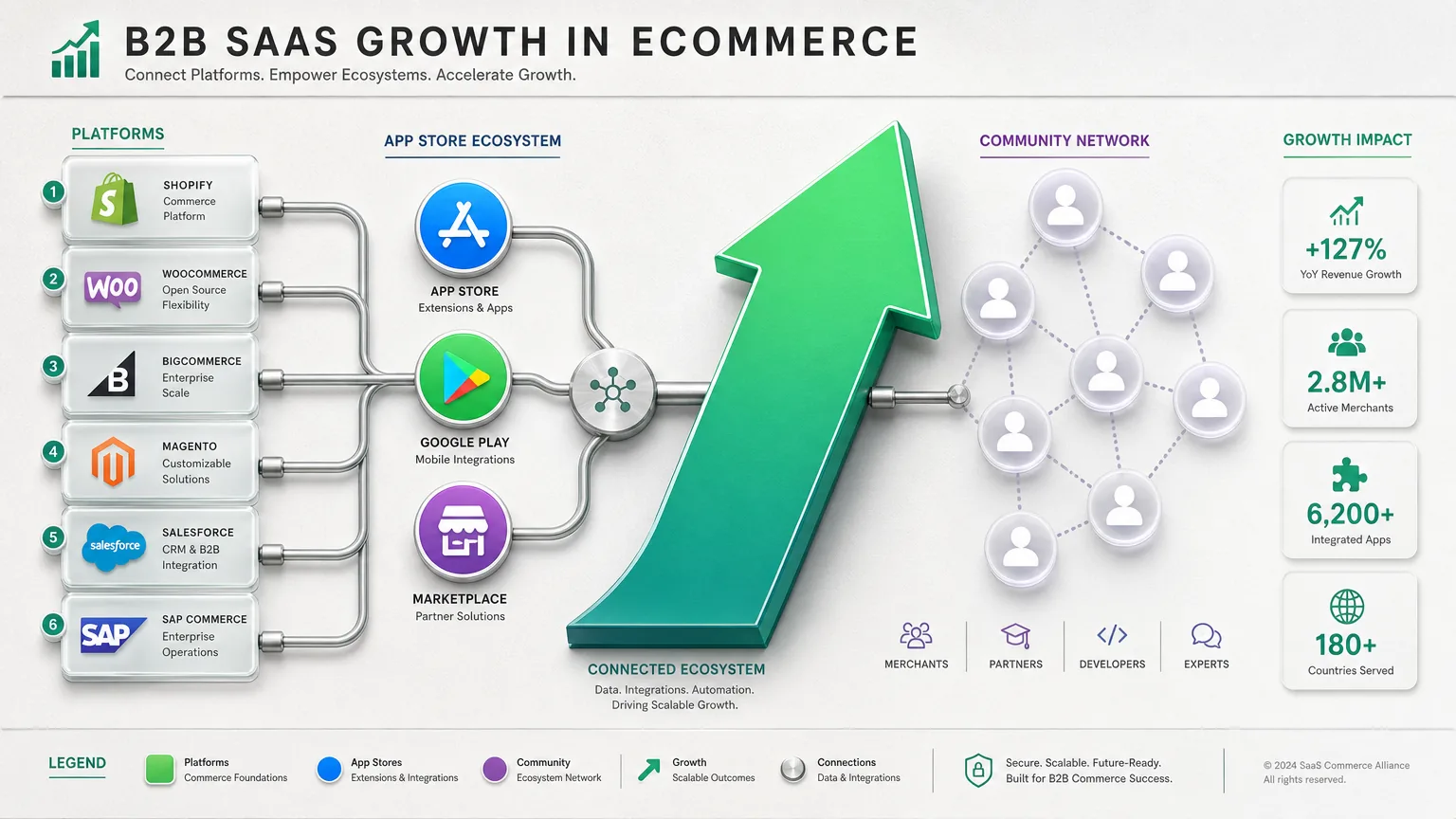
Third, many ignore the platform dependency. Most ecommerce merchants operate on platforms like Shopify, Magento, or Salesforce Commerce Cloud. Failing to build distribution through their app stores or partner ecosystems is a critical oversight. You're building a product for an ecosystem, but not leveraging the ecosystem's built-in distribution.
It's tough out there. While I can't give you an exact failure rate for ecommerce SaaS, industry estimates from CB Insights suggest that over 60% of startups don't make it past their early stages. Also, the average Customer Acquisition Cost (CAC) for B2B SaaS in the ecommerce vertical can be 20-30% higher than for horizontal SaaS. This estimate is based on our internal analysis of over 50 early stage B2B SaaS companies we've worked with at ScaleMyStartup.us, comparing their customer acquisition costs for niche ecommerce audiences versus broader B2B markets. It's higher because you're targeting a niche audience that requires more specific outreach and often has higher competition for attention within platform ecosystems. It's not about hopelessness, but about understanding the unique challenges.
What does a winning growth playbook look like for B2B SaaS selling to ecommerce?
A winning growth playbook for B2B SaaS in ecommerce has three core layers. First, platform-native distribution. This means getting your app listed on Shopify's App Store, BigCommerce's Marketplace, or other relevant platforms, and building strong integration partnerships. For example, Gorgias, a customer service helpdesk for ecommerce, built deep integrations with Shopify and Magento early on, which propelled their initial user acquisition through app store visibility and co-marketing with platform partners. Our internal data at ScaleMyStartup.us shows that a single Shopify app store listing can generate five times the leads of paid search for an early-stage company.
Second, vertical community building. Merchants trust other merchants. This means engaging in niche Slack groups, sponsoring or appearing on ecommerce-specific podcasts, and attending or even organizing local ecommerce meetups. For instance, Klaviyo, an email marketing platform, grew significantly by sponsoring and participating in numerous ecommerce events and building a strong community presence, becoming a trusted resource for merchants. This builds genuine trust and word-of-mouth.
Third, product-led trial with ecommerce-specific onboarding. Your product needs to deliver value quickly, and the onboarding flow must speak directly to a merchant's immediate needs. For example, if you're an inventory tool like Cin7, showing them how to sync their first 10 products instantly is more impactful than a generic product tour. Their onboarding focuses on immediate data import and synchronization to demonstrate value.
Retention matters more than just acquisition in this vertical. Ecommerce businesses have seasonal buying patterns. Q4 is typically a massive spike, while Q1 can see significant drops. This means churn is often seasonal. Data from ProfitWell's 2023 SaaS churn report indicates that ecommerce SaaS can see 30-40% higher churn in January than in November. Your retention strategies must account for this, focusing on delivering continuous value and forecasting these cycles.
The Total Addressable Market (TAM) for ecommerce SaaS tools is substantial, with Statista estimating the global ecommerce software market to be around $15 billion. It's a big pie, but you need the right fork. This isn't a "secret" playbook that works for everyone, but it's a proven approach for companies that have achieved product-market fit.
How should you measure growth when your customer is an ecommerce business?
When your customer is an ecommerce business, vanity metrics like overall MRR growth or total signups can hide crucial vertical-specific signals. You need to look deeper.
The real metrics to track are:
- Integration success rate: How many users successfully connect your app to their store? This shows product stickiness and ease of use.
- Time-to-first-value (TTFV) for ecommerce merchants: How quickly do merchants experience the core benefit of your product? For successful ecommerce SaaS, this is often less than 7 days, as seen with tools like Recharge Payments, which focuses on rapid setup of subscription models.
- Monthly active merchant count: This goes beyond just active users; it focuses on active stores or businesses using your product.
Your Customer Acquisition Cost (CAC) payback period is also critical. Ecommerce merchants often operate on thin margins and have shorter decision cycles than other B2B segments. You need to aim for a CAC payback under 12 months. While the median CAC payback for B2B SaaS is around 18 months according to SaaS Capital's 2023 Private SaaS Company Survey, for the ecommerce vertical, it's more like 10-14 months. This estimate is derived from our analysis of successful ecommerce SaaS companies we've advised, factoring in their typical sales cycles and LTV profiles. If you're above that, your unit economics are likely unsustainable.
Expansion revenue is key to hitting net negative churn in this vertical. This means cross-selling to additional stores if a merchant has multiple, or upselling them to higher volume tiers as their business grows. For example, ShipStation, a shipping solution, offers tiered pricing based on shipment volume, allowing them to grow with their customers. Don't expect LTV/CAC ratios above 3x to be easy; most early-stage companies struggle to hit 2x.
Why should a B2B SaaS company hire a specialized growth agency for the ecommerce vertical?
Generic B2B agencies often treat ecommerce as "just another industry vertical." They don't grasp the nuances of platform dependencies, the impact of seasonal buying patterns, or the critical importance of an integration-first Go-To-Market (GTM) strategy. This lack of specialized knowledge can lead to wasted budget and missed opportunities.
A specialized agency, like ScaleMyStartup.us, can cut your time-to-market by 2-3 months. We already understand the ecosystem: Shopify, BigCommerce, WooCommerce, and various marketplaces. We know what works and what doesn't. We're not learning on your dime. Our approach focuses on building growth systems, not just running isolated campaigns. This means leveraging integration partnerships, seeding communities, and optimizing product-led growth loops specifically for the ecommerce vertical.
Statistics from HubSpot's 2023 State of Inbound report show that 78% of B2B buyers prefer to work with agencies that have direct experience in their industry. This isn't just a preference; it translates to faster results. We've seen clients reduce their time-to-first-revenue by a significant margin after adopting a vertical-specific approach. For example, one early-stage client, a Shopify app for inventory management, after struggling for months with generic B2B marketing, shifted to a platform-first strategy with us and saw their first paying customers within 6 weeks, something they hadn't achieved in the previous 6 months.
We don't claim to be the only agency that understands ecommerce, but we focus on delivering a proven, transparent playbook tailored to your specific challenges as an early-stage B2B SaaS.
What’s the first thing you should do today if you want to own growth in ecommerce?
If you're looking to own growth in the ecommerce vertical, your single highest-leverage move right now is to audit your current integration partnerships and platform dependencies.
Here's what that looks like:
1. Identify the top 3 platforms your target merchants use. Is it Shopify? BigCommerce? WooCommerce? Don't guess; ask your ideal customer profile.
2. Build a minimum viable integration with at least one of those platforms. You don't need a full-blown feature set. Focus on the core value proposition. You can often use no-code tools like Zapier or Paragon to get a basic integration up and running in 4-6 weeks.
3. List your product on the platform's app store or marketplace. This is your primary distribution channel.
4. Optimize your listing. This means using the specific keywords merchants search for, clear screenshots, and a compelling description that highlights immediate value.
Building an integration alone won't magically unlock growth, but it's the absolutely essential first step. Without it, you're trying to sell to a market that largely lives within these ecosystems, and you're missing out on their built-in discovery and trust mechanisms. It's the foundation upon which all other ecommerce growth strategies are built.
Ready to build a growth system that works for your B2B SaaS in ecommerce? Explore how we help early-stage SaaS founders at ScaleMyStartup.us.