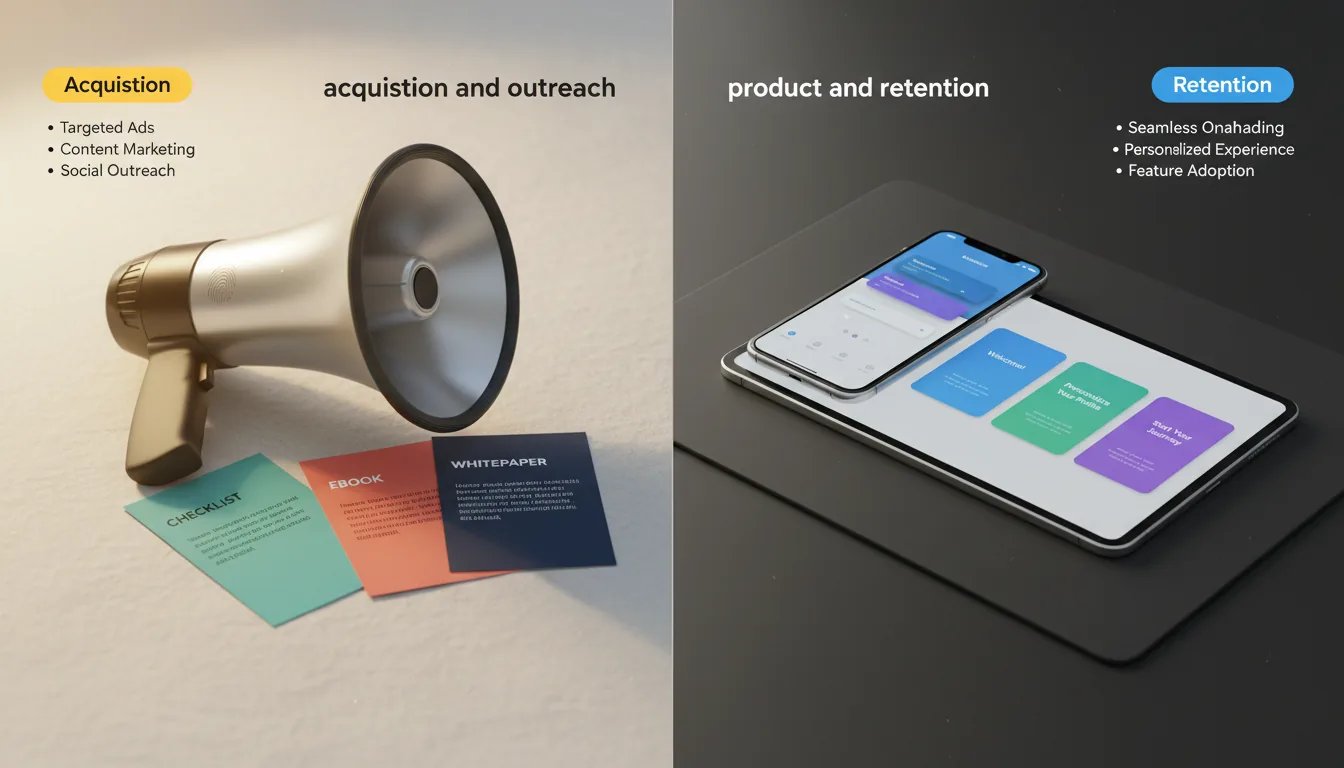
For a SaaS startup, choosing between a demand generation agency and a product-led growth (PLG) agency depends on the Average Contract Value (ACV), the sales motion, and the current growth stage. The right choice aligns with the product's user acquisition path and your business's immediate growth needs.
What is a demand generation agency, and what does it do for SaaS?
A demand generation agency agencies focus on creating interest and capturing existing demand for a SaaS product to fill the top of the sales funnel with qualified leads. These agencies drive awareness and bring potential customers to a digital doorstep.
Demand generation agencies typically handle activities such as:
- Paid Advertising: They run campaigns on platforms like Google Ads, LinkedIn, Meta, and Reddit to target specific audiences. This includes keyword research, ad copy creation, landing page optimization, and continuous A/B testing.
- Content Marketing: They produce blog posts, whitepapers, case studies, and webinars to attract and nurture prospects. The goal is to establish thought leadership and answer common customer questions.
- SEO (Search Engine Optimization): They optimize websites and content to rank higher in search engine results for relevant keywords, driving organic traffic.
- Email Marketing & Nurturing: They build email lists, create automated sequences, and send targeted campaigns to move leads through the sales funnel.
- Webinars & Events: They organize online events or support presence at industry conferences to generate leads and build brand authority.
- Lead Scoring & Qualification: They help define what a "qualified lead" looks like and set up systems to score and route those leads to the sales team.
The value proposition of demand generation agencies is to bring potential customers who are already looking for solutions or can be convinced they need one. They are often measured by agencies focus on metrics like Marketing Qualified Leads (MQLs), Sales Qualified Leads (SQLs), website traffic, and pipeline generated.
What is a product-led growth (PLG) agency, and what does it do for SaaS?
A product-led growth agency believes the product is the primary driver of acquisition, conversion, and retention by optimizing the user's journey within the product. These agencies aim to make the product itself the best salesperson.
PLG agencies typically offer services including:
- Onboarding Optimization: They redesign the initial user experience to help new users quickly achieve their "aha!" moment and understand the core value of the product. This often involves in-app guides, tooltips, and personalized walkthroughs.
- Feature Adoption & Engagement: They identify underutilized features and design strategies like in-app messages, email sequences, or tutorials to encourage users to explore them.
- Conversion Rate Optimization (CRO): They A/B test pricing pages, signup flows, and in-app upgrade prompts to maximize the conversion of free users to paid customers.
- Freemium/Trial Strategy: They design and optimize the terms, limitations, and upgrade paths for free tiers or trial periods to balance user acquisition with monetization.
- User Feedback Loops: They implement systems to collect, analyze, and act on user feedback to continuously improve the product experience.
- Product Analytics & Instrumentation: They set up robust tracking to understand user behavior within the product, identify drop-off points, and measure the impact of changes.
PLG agencies focus on metrics like activation rate, feature adoption, free-to-paid conversion rates, user engagement, and churn reduction. They work closely with product and engineering teams, often acting as an extension of an internal growth team.
How do demand generation and PLG agencies compare side-by-side?
Demand generation and PLG agencies differ in their approach, best fit, timeline to results, cost structure, and key risks. Hybrid models like Growth-as-a-Service (GAAS) combine elements of both.
| Approach | Best For (ACV/Sales Motion) | Typical Timeline to Results | Cost Structure | Key Risk |
|---|---|---|---|---|
| Demand Gen Agency | High ACV ($5,000+), Sales-led, Complex products, Established market | 3-6 months for initial traction | Monthly retainer, often performance bonuses | High CAC if targeting is off, leads don't convert to sales |
| PLG Agency | Low-to-mid ACV ($50-$5,000), Product-led, Self-serve, Wide appeal | 4-9 months for significant impact | Monthly retainer, project-based for specific sprints | Product isn't ready for self-serve, focus on vanity metrics, no traffic |
| Hybrid/GAAS (like ScaleMyStartup) | Any ACV, evolving sales motion, early-stage SaaS seeking integrated strategy | 3-12 months for measurable, sustainable growth | Monthly retainer, often value-based or tiered | Requires deep collaboration, not a "set it and forget it" solution |
Demand generation can deliver leads quickly if the offer is clear and the market is defined, but a poor product experience can lead to wasted ad spend. PLG builds a sustainable growth engine by optimizing the product, but it requires a fundamentally good product and can be slow to show results without initial awareness. Hybrid/GAAS models aim to bridge this gap, ensuring that demand generated lands on a product that converts and retains users. This approach requires a more holistic view and often involves iterating on both acquisition and product experience simultaneously.
How can a SaaS founder decide which agency fits their needs?
The decision depends on specific signals related to the SaaS product's characteristics and market position. Founders should evaluate their ACV, sales motion, and product complexity to identify their biggest growth bottlenecks.
When does a SaaS startup need demand generation first?
A SaaS startup likely needs to prioritize demand generation if:
- High ACV ($5,000+): The product requires a sales conversation to close deals, justifying the cost of acquiring leads through demand gen.
- Complex Product/Solution: The SaaS solves a sophisticated problem that requires explanation, demonstration, or significant setup, as users won't "figure it out" on their own.
- Sales-Led Motion: A sales team is already in place, and the customer journey involves demos, custom quotes, and relationship building.
- Targeted Niche: The product serves a very specific industry or persona, making it efficient to reach them through targeted ads or content.
- New Market/Category Creation: The product is novel, and the market needs education about the problem it solves before seeking a solution.
In these scenarios, getting qualified leads into the sales pipeline is the most direct path to revenue. According to HubSpot's 2024 State of Marketing Report, companies with well-defined demand generation strategies see significantly higher lead-to-customer conversion rates.
When does a SaaS startup need PLG first?
A SaaS startup should lean into product-led growth if:
- Low-to-Mid ACV ($50 - $5,000): The product is priced such that a sales team isn't cost-effective for every deal, making self-serve critical for profitability.
- Intuitive, Self-Serve Product: The SaaS can deliver value quickly without extensive human intervention, allowing users to sign up, onboard, and get started on their own.
- Broad Appeal/Large TAM: The product solves a common problem for a wide audience, enabling a viral or word-of-mouth component.
- Freemium or Free Trial Model: A free version or trial is already offered, and the challenge is converting those users into paying customers.
- High Churn in Early Stages: Users are signing up but not sticking around or upgrading, indicating a problem within the product experience.
OpenView's 2023 SaaS Benchmarks Report highlights that PLG companies often achieve higher revenue per employee and lower customer acquisition costs (CAC) due to their efficient growth model.
When does a SaaS startup need both demand generation and PLG (a hybrid motion)?
Many SaaS companies benefit from a hybrid approach, especially as they scale. This is often the case if:
- Scaling Up: Initial product-market fit (PMF) has been found with a PLG motion, but there's a desire to move upmarket to larger customers with higher ACVs, which often requires a sales touch.
- Complex Features/Enterprise Tiers: The product has a self-serve core but also offers advanced features or enterprise plans that require demos, custom pricing, or integration support.
- Competitive Market: There is a need to both attract attention through demand generation and ensure a superior product experience through PLG to stand out.
- Early Stage, Testing GTM: The optimal go-to-market (GTM) strategy is still being figured out, requiring experimentation with both acquisition channels and product conversion flows simultaneously.
For example, a company might use demand generation to drive traffic to a free trial, then use PLG tactics to convert those trial users, and finally, a sales team to upsell them to enterprise plans. This integrated approach can be powerful.
What are common mistakes founders make when choosing a growth partner?
Picking the wrong growth partner can be costly in terms of money and lost time. Common pitfalls include:
1. Chasing the Hype: Adopting a strategy simply because it's trendy, without assessing if it fits the product, market, and business model.
2. Ignoring Product-Market Fit: Hiring a demand generation agency when the product doesn't solve a real problem or is buggy, which leads to wasted ad spend. Conversely, hiring a PLG agency when nobody knows the product exists is ineffective.
3. Expecting Miracles Overnight: Growth takes time; demand generation campaigns and PLG improvements require iterative testing. Expecting significant, sustainable results in under 3-6 months is unrealistic.
4. Not Defining Success Metrics: Without clear Key Performance Indicators (KPIs) like qualified leads or activation rate, measuring an agency's effectiveness is difficult, leading to frustration and wasted investment.
5. Lack of Internal Alignment: Growth requires marketing, product, and sales to work together. If internal teams are not on board or cannot execute on recommendations, even the best strategy will fail.
6. Focusing Solely on Acquisition: Many founders focus on new sign-ups but neglect retention and monetization. A holistic view of the customer lifecycle is crucial, as ProfitWell (now Paddle) data shows that improving retention by just 5% can increase profits by 25-95%.
How does ScaleMyStartup approach the decision between demand generation and PLG?
ScaleMyStartup operates as a Growth-as-a-Service (GAAS) accelerator, blending elements of both demand generation and product-led growth tailored to a startup's specific stage and goals. The "Stealth GTM Framework" is agile and data-driven.
ScaleMyStartup starts by understanding the product, target audience, and existing user behavior. This diagnostic phase determines whether the immediate bottleneck is awareness (requiring demand generation), conversion within the product (requiring PLG), or a combination. Experiments are prioritized based on their potential to yield significant insights and impact on core growth loops. For example, ScaleMyStartup helped an AI startup scale from 10,000 to 2 million users at a $0.02 CAC by optimizing both user discovery and in-product experience. This approach focuses on building a repeatable, scalable growth engine rather than running one-off campaigns. More information about this framework is available at (@L11).
Frequently Asked Questions
Can a SaaS startup use both demand generation and PLG at once?
Yes, many successful SaaS companies employ a hybrid strategy. Demand generation can drive traffic to a free trial or freemium product, and PLG tactics can then optimize the in-product experience to convert those users. The key is to ensure both strategies are aligned and working towards common goals.
How much does a demand generation agency cost versus a PLG agency?
Costs vary widely based on the agency's experience, scope of work, and location. Generally, both types of agencies charge monthly retainers, often starting from $5,000 to $15,000+ per month for early-stage SaaS. Demand generation agencies might also have ad spend budgets on top of their fees. PLG agencies might also charge project fees for specific product sprints.
What's the difference between Growth-as-a-Service and a traditional agency?
Growth-as-a-Service (GAAS) models, like ScaleMyStartup, typically offer a more integrated, strategic partnership than traditional agencies. GAAS providers often embed more deeply with a client's team, focus on the entire growth funnel, and may tie their incentives more closely to overall business outcomes, acting as an extension of the growth team rather than just a vendor for specific services.
When should a SaaS startup switch from PLG to demand generation (or vice versa)?
It's rarely a hard switch but more of an evolution. If a startup began with PLG and hit a ceiling on organic growth, it might layer in demand generation to reach new audiences. If it started with demand generation but observed high churn or low conversion from leads, it would invest more in PLG to fix the product experience. The ACV and market dynamics often dictate the primary focus.
Do I need a PLG agency if my product already has self-serve signup?
Having self-serve signup is a prerequisite for PLG, but it does not mean the product is optimized for growth. A PLG agency can analyze user behavior, identify friction points, and optimize onboarding flows. They also run experiments to increase activation, conversion, and retention rates, even if a basic self-serve option exists.
What are the key takeaways and next steps for choosing a growth agency?
Choosing between a demand generation or PLG agency is about aligning with a SaaS startup's current reality. Founders should evaluate their ACV, sales motion, and product complexity to identify their biggest growth bottlenecks. Many successful paths involve a blend of both, evolving as the business matures.
If you are an early-stage SaaS founder trying to grow for a partner to help navigate these decisions and build a scalable growth engine, ScaleMyStartup might be a good fit. ScaleMyStartup is selective about who they work with to ensure they can deliver real impact. If you are ready to build a data-driven growth strategy, you can reach out to ScaleMyStartup at (@L13).
Work with ScaleMyStartupDeciding between outside help and a team of your own? Read Embedded growth team vs agency: which fits your stage, or see how our embedded growth team works.